
Fear, Growth, and Leadership: Year Two on the Mountain with My Kid

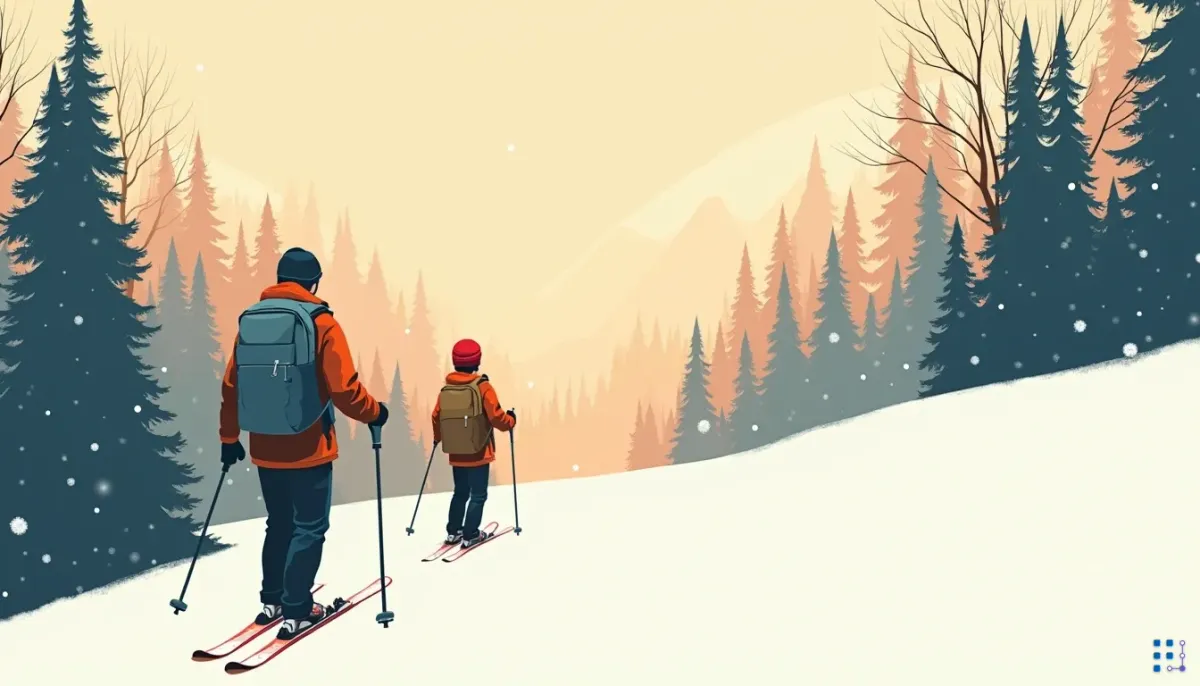
A year ago, I wrote about skiing with my 9-year-old (now 10) and how the experience mirrored so much of what I see in the workplace. The fearless kid. The cautious adult. The tension between "just go" and "learn the basics first." A year later, the core of that story hasn't changed. But we have.
From Blues to... Everything
Last year, we ended the season on black diamonds and blue glades at one resort, feeling proud. This year? New mountains. New terrain. Blacks, moguls, glades, ungroomed. All of it. Every new mountain brought new skills, new challenges, and new runs that made last year feel like warmup. His control is better. My form is better. We're both meaningfully improved, and skiing together has become this thing we share that I genuinely treasure.
But the dynamic is the same. He is fearless. I proceed with caution.
I still have fear. It shows up mostly around speed and unfamiliar terrain we've never seen before. A new run, a steep drop-in, a section of trees I can't scope from above. That's where my brain kicks in and starts running calculations. His brain? Already halfway down.
Faith
Here's what changed the most: there is almost no terrain he goes where I'm not willing to follow. That's a big shift from last year, where I was constantly lecturing him about being ready. Now, I have total faith in him. I don't worry he's going to get hurt. I've watched him recover from enough tough spots to know he can handle it.
What I do think about is his form. I want it to be better. Not because he's bad. Some people would argue he's the better skier between us. Watch him navigate moguls or bomb a steep line and you'd have a hard time arguing otherwise. Watch us both cruise a blue groomer and you'd probably say I look more polished. I'm not sure what any of that means on its own.
What I know deep down is this: if he starts to get closer to "standard" technique, parallel turns, proper edging, body position, he can progress at an exponential level. The raw ability is clearly there. The fearlessness is there. If the mechanics catch up, the ceiling disappears.
The Hardest Part
So how do you encourage technical improvement without killing the thing that makes him special? That wild, nonchalant exploration. The willingness to point it downhill and figure it out on the way. That's the hardest part, and honestly, it's the thing I'm still working through for next season.
A moment that captured this perfectly: my wife decided she wanted to try skiing for the first time. I gave her the careful advice. Start slow. Stay with what's comfortable. Build from there. His advice? "Mom... don't be scared. Just go."
That's him in a nutshell.
The One-Ski Moment
The coolest thing I saw all season started with a small disaster. His ski popped off getting on the lift. Instead of being frustrated, he treated it like a challenge. Can I ski down on one foot?
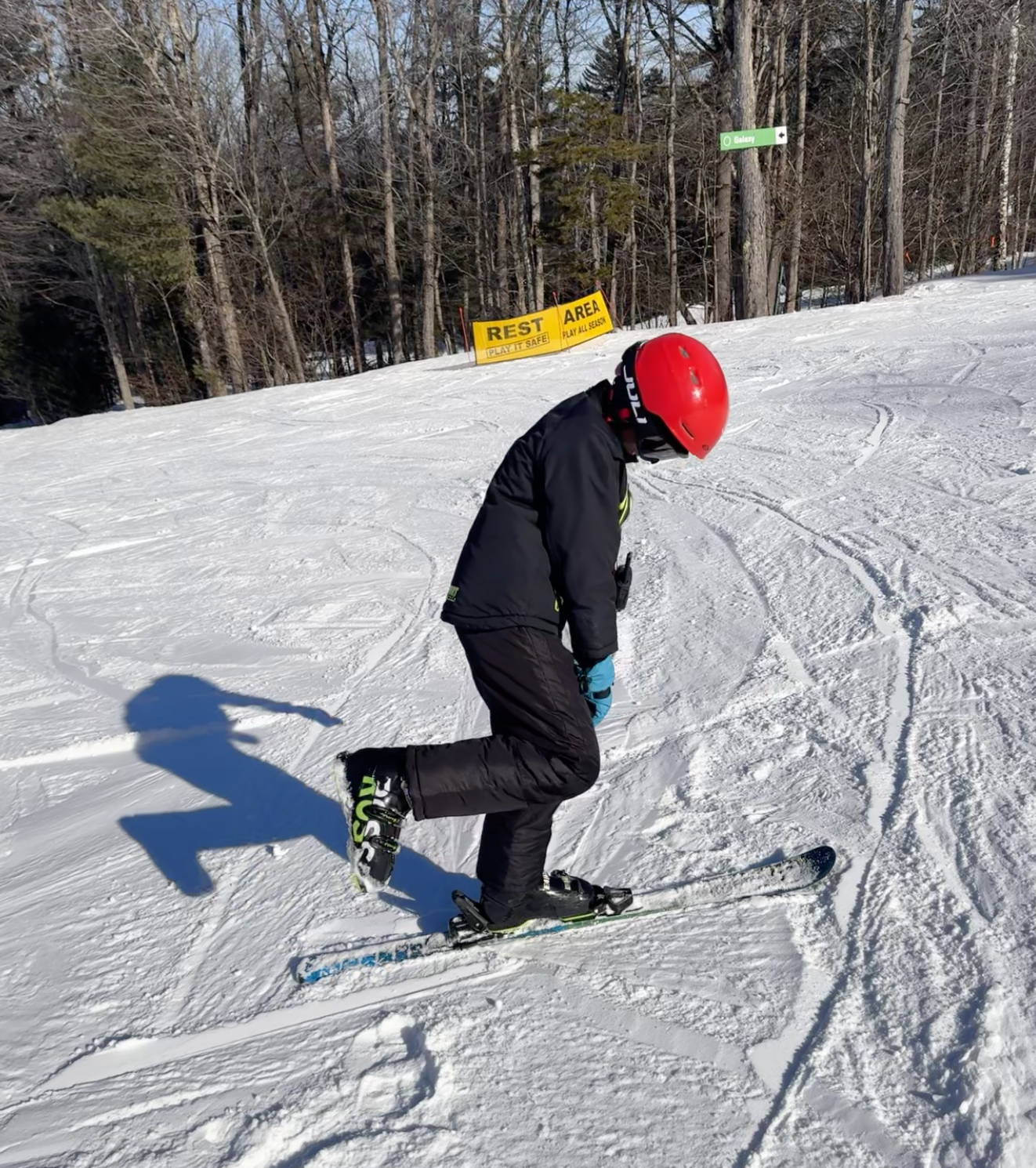
We took a green run. He struggled. A lot. But he wanted to figure it out. And somewhere on that run, he had a genuine aha moment. He told me he learned more about how his edges work from that one run than anything else all season.
What happened next surprised me. He wanted to stay on the green runs. For the rest of the day. Without me pushing him. He started practicing his turns based on what he'd just felt. Each run, a little faster. A little more confident. Throwing in small jumps at the end. Then bigger jumps. Then jumps specifically designed to scare me.
He discovered a new skill on his own terms, in his own way, and then voluntarily went back to basics to build on it. No lecture from me required.
Letting Go (a Little)
We got walkie-talkies this year. That was a big step. It meant he could do approved runs without me. The rule was simple: no trees. Stay on runs we've done together. Check in on the radio.
Watching him ski off alone and hearing his voice crackle through the walkie-talkie with "Dad, that was awesome" might be the highlight of my year. At no point do I want to discourage him. I try to encourage while keeping things safe. It's a balance I think about constantly.
Back to Work
Last year I drew parallels between generational dynamics on the slopes and in the workplace. This year, the correlation that hits hardest is in the AI world.
You see people who deeply understand where AI can go wrong, and they cringe at others trusting it with 100% of their code. Fair. There are real risks. But instead of embracing the opportunity to learn together and shape how the tool gets used, they turn up their nose. They complain that people don't read the code. They gatekeep instead of guide.
Sound familiar? It's the same pattern. The cautious expert looking at the fearless newcomer and saying "you're not ready" instead of "let me help you get better at this." I've written about this tension before. The risk of over-reliance is real. But the answer isn't to dismiss the tool or the people using it.
AI is a tool. Not using it is not the answer. Understanding how to use it, and having a voice in shaping its future, that's where the energy should go.
Like skiing, we need both sides. We need the people who use it boldly, maybe a little recklessly, pushing into terrain they haven't fully scoped out. And we need the people with judgment and experience who can spot the dangers. If you refuse to use the tool, you will fall behind. If you rely on the tool without understanding the fundamentals, you will hit a wall and won't know how to recover when things break.
The sweet spot is somewhere in the middle. Use it. Learn it. Respect it. And don't look down on the people approaching it differently than you.
It will get there. Not yet. But it will. And the people who figure out how to balance boldness with fundamentals? They're the ones who will be skiing the whole mountain.